
Mimosa B5 Installation Case Study: Point-to-Point Wireless for 4K Camera Backhaul
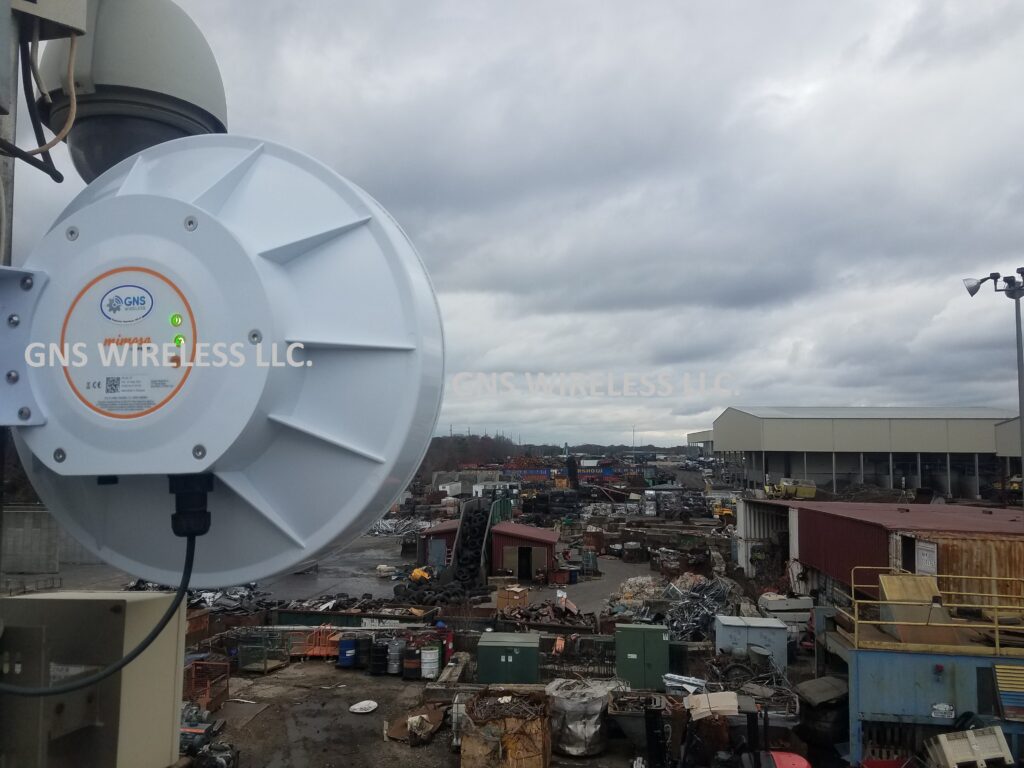
Designing a reliable point-to-point wireless installation for a large industrial site is very different from deploying radios in a clean, rural RF environment. This Mimosa B5 installation was completed at a large construction and recycling yard, where the customer required extremely high reliability and sustained throughput to support dozens of real-time 4K security camera streams.
For this project, GNS Wireless deployed the Mimosa B5 as a short-range point-to-point wireless backhaul solution connecting multiple areas of the yard.
Project Overview: Industrial Wireless Camera Backhaul
-
Application: Wireless backhaul for 4K security cameras
-
Industry: Construction & recycling
-
Technology: 5 GHz point-to-point wireless
-
Line of Sight: Clear LOS on both links
-
RF Environment: Heavy 5 GHz interference
-
Network Role: Core transport for live video monitoring
Link Distances
-
Link #1: ~¼ mile
-
Link #2: ~⅓ mile
These distances fall squarely into what GNS considers the ideal range for short-range point-to-point wireless, especially in noisy industrial environments.
Why This Network Was Demanding
This was not a casual data link.
The customer relied on these links for:
-
Real-time monitoring of dozens of 4K cameras
-
Continuous video streaming with no buffering
-
Reliable recording and playback
-
Low latency for operational awareness
This type of industrial wireless camera backhaul demands:
-
Sustained throughput
-
Stable modulation
-
Minimal packet loss
-
Zero random link drops
Installation Challenges: Signal Levels & RF Saturation

Initial Power-Up Observations
When the Mimosa B5 radios were first powered on and the point-to-point links were established:
-
Signal levels were too strong, measuring in the low –30 dBm range
-
Radios were effectively running hot
-
Excessive signal strength can reduce link efficiency and long-term stability
This is a common issue in short-range point-to-point wireless installations, particularly when using high-gain integrated antennas with clear line of sight.
AUTO Configuration vs Manual Tuning
The Mimosa B5 allows installers to select an AUTO configuration mode, where the radio automatically chooses:
-
Channel
-
Channel width
-
Transmit power
-
Based on an RF scan
While AUTO mode is convenient, it is rarely optimal for high-throughput industrial wireless backhaul, especially when:
-
RF interference is heavy
-
Camera traffic is continuous
-
Latency consistency matters
Manual Configuration Strategy
For this Mimosa B5 point-to-point deployment, GNS Wireless manually adjusted:
-
Transmit power (to bring signal levels out of the –30s)
-
Channel selection
-
Channel width
This approach allowed us to:
-
Reduce RF saturation
-
Improve modulation stability
-
Maintain consistent throughput for video traffic
Channel Width & Duplex Mode Optimization
The Mimosa B5 offers flexibility beyond a standard setup:
-
Standard 80 MHz channel
-
Full Duplex 80 MHz mode, which provides:
-
Higher usable capacity
-
Lower latency
-
Better performance for video-heavy applications
-
Final Configuration (The Sweet Spot)
After testing multiple options, both links performed best with:
-
Operating frequency: Lower 5 GHz range (~5300 MHz)
-
Channel width: Full Duplex 80 MHz
-
Transmit power: Manually reduced for optimal RSSI
This configuration delivered the most stable short-range point-to-point wireless performance in a heavily congested RF environment.
Real-World Mimosa B5 Throughput Results
With the links properly tuned:
-
Observed sustained throughput: ~500 Mbps
-
Stable performance under continuous load
-
Reliable transport for multiple simultaneous 4K video streams
Important Throughput Reality
Even at short distances:
-
Full gigabit capacity was not achievable
-
RF noise and interference capped usable throughput
This is an important takeaway for anyone planning a Mimosa B5 installation for cameras.
Distance Guidance: What GNS Wireless Recommends
Based on this deployment and extensive field experience:
✅ Ideal Use Case
-
¼ mile
-
Clear line of sight
-
Wireless backhaul for 4K security cameras
⚠️ Acceptable With Care
-
Up to ½ mile, with:
-
Excellent LOS
-
Manual tuning
-
Realistic throughput expectations
-
❌ Not Recommended
-
Beyond ½ mile
-
Non-line-of-sight paths
-
Applications requiring guaranteed gigabit throughput
Unless you are operating in an extremely clean RF environment, the Mimosa B5 should be viewed as a short-range point-to-point wireless solution, not a long-haul backhaul radio.
Why GNS Wireless Was Chosen
This project succeeded because the network was engineered, not guessed.
GNS Wireless Services Include:
-
Pre-configured Mimosa B5 radios
-
RF planning and channel selection
-
Manual power and channel optimization
-
Professional point-to-point wireless installation
-
U.S.-based technical support
Product & Services
-
🔗 Mimosa B5 Point-to-Point Wireless Antenna
👉 Available on gnswireless.com -
⚙️ Pre-Configuration Available
Optimized before shipment for your distance, RF environment, and application. -
📡 Installation Services Available
Ideal for construction sites, recycling yards, and industrial camera networks.
Final Takeaway
This Mimosa B5 installation case study demonstrates an important truth:
Short-range point-to-point wireless can deliver excellent real-world performance — but only when it’s properly tuned.
For industrial wireless camera backhaul, design discipline matters more than spec sheets.
👉 Contact GNS Wireless to design, pre-configure, and install a point-to-point wireless solution that performs in the real world — not just on paper.